Introduction
On November 30, 2022, OpenAI launched ChatGPT, a chatbot that has been hailed as a pivotal moment in human history, likened to the steam engine and the iPhone. This revolutionary technology in generative AI has sparked a wave of innovation across the tech industry, prompting a re-evaluation of software and hardware.
The Impact of Generative AI
The past year has witnessed a surge in the value of AI infrastructure providers, enabling advancements in various fields from healthcare to aerospace. However, this technological shift has also generated anxiety about AI’s potential threats to human existence and job security. OpenAI itself faced a crisis, nearly experiencing a collapse.
Questions About the Future
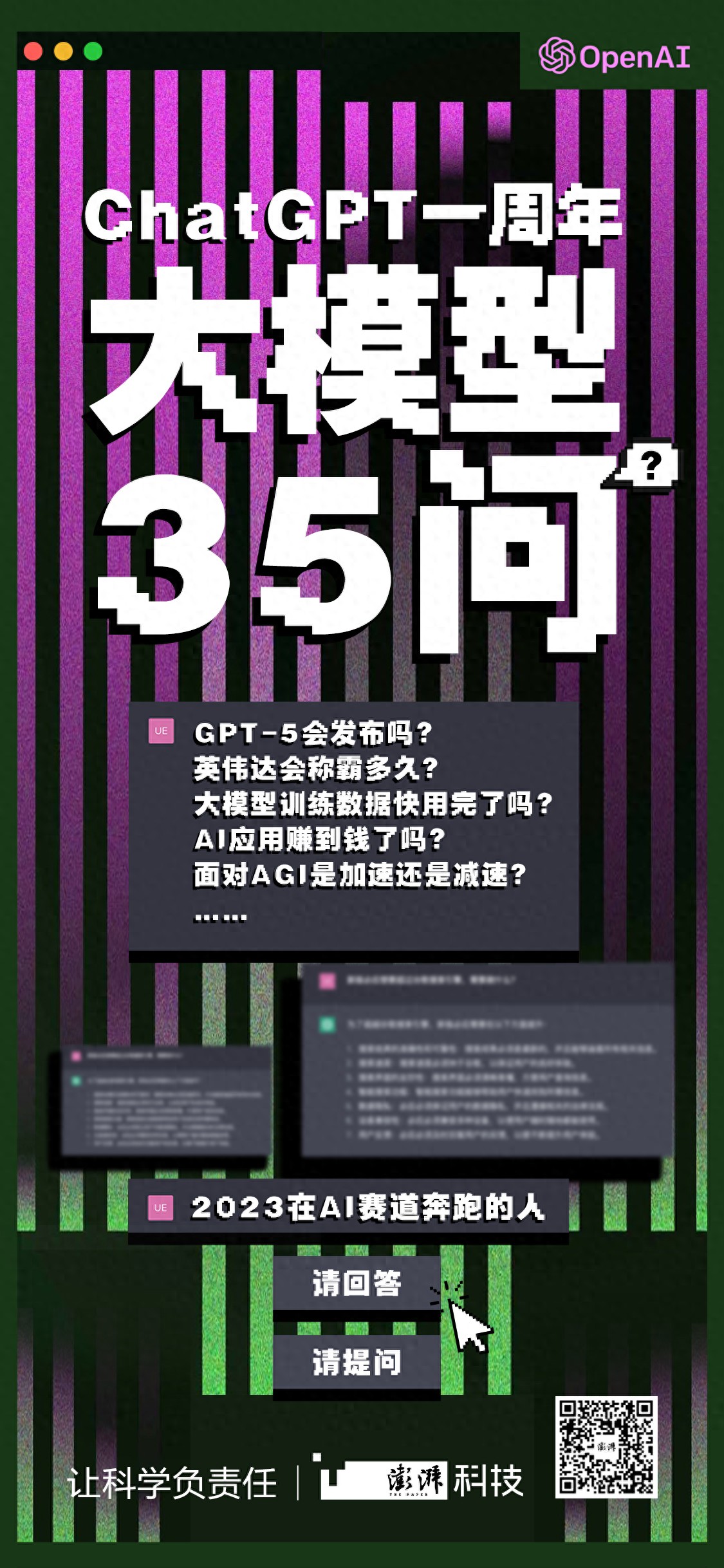
As the industry evolves, several questions arise: What will be the next evolution of large language models? When will the AI chip shortage be resolved? Are we running out of training data? How will the competition among AI models in China unfold? Should the development of AI technologies accelerate or decelerate? Will AGI (Artificial General Intelligence) manifest in different forms? To address these questions, we invited industry experts to share their insights and pose their own questions.
OpenAI’s Position and Competitors
OpenAI, previously unknown to the public, has become one of the most recognized tech companies globally within a year, creating competitive pressure for giants like Google, Meta, and Amazon. Many are curious about the release date of GPT-5 and who might challenge OpenAI’s dominance.
Zhang Peng, CEO of Zhiyuan AI, stated that while OpenAI is leading, it should not overshadow other competitors. He emphasized that true challengers must have a strong technical foundation and deep understanding. Professor Xiao Yanghua from Fudan University noted that once a model approaches AGI, its upgrade and evolution could be astonishingly rapid, raising concerns about widening gaps.
User Growth and Challenges
After explosive early growth, OpenAI’s user growth has slowed, which is considered normal. Wang Xiaohang, VP of Ant Group, mentioned that the evolution of model capabilities is data-driven, and the availability of publicly accessible data is dwindling. He suggested two paths forward, emphasizing that AGI, as a centralized product, is not yet a high-frequency necessity for the public. The industry trend is shifting towards creating a super ecosystem rather than a centralized super AI.
Future Directions for Large Language Models
In interviews, industry leaders proposed several directions for the evolution of large language models. Liu Qingfeng, chairman of iFlytek, highlighted the need for larger model parameters, the creation of AI personas, and deeper customization across various industry scenarios. Wang Fengyang from Baidu emphasized the importance of intelligent agents, while Zhou Bowen from Xiangyuan Technology discussed the potential for AI to effectively use tools, which he termed tool intelligence.
The Competitive Landscape in China
Following the launch of ChatGPT, Chinese tech companies entered a heated competition dubbed the “Hundred Model War,” involving both established firms and rapidly funded startups. Chen Lei from Xinyi Technology predicted a more objective market in the coming year, with a focus on practical applications and a reduction in the number of foundational models.
Open Source vs. Closed Source Models
As OpenAI becomes less open about its model parameters and training details, the question arises: Can open-source models surpass closed-source ones? Liang Jiaen, chairman of Yunzhisheng, estimated that while open-source models might have a broader impact in terms of application quantity, closed-source models may achieve higher performance levels.
Insights from Industry Experts
The following are key insights from the interviews:
- Will GPT-5 be released? Experts agree that further iterations like GPT-5, GPT-6, and GPT-7 are inevitable, but the timeline remains uncertain due to market conditions and safety evaluations.
- Who will challenge OpenAI? Competitors include tech giants like Microsoft and Google, as well as startups like Anthropic and Inflection AI. The consensus is that achieving AGI is a common goal among these entities.
- How to address OpenAI’s slowing growth? Experts suggest that the slowdown in user growth is normal and that the focus should shift to integrating AI into various industries to create real demand.
Conclusion
The future of generative AI is filled with potential and challenges. As the industry continues to evolve, the focus will be on practical applications, the development of intelligent agents, and the integration of AI into everyday tasks. The competition will not only be about who can create the best models but also about who can effectively apply these technologies to solve real-world problems.
Comments
Discussion is powered by Giscus (GitHub Discussions). Add
repo,repoID,category, andcategoryIDunder[params.comments.giscus]inhugo.tomlusing the values from the Giscus setup tool.