1. Conclusion: AI is not a “thinking human” but a “learning tool”
In recent years, artificial intelligence (AI) has become one of the hottest topics. Some believe it can do everything, while others fear it will replace human jobs, and some think of it as a “machine that thinks like a human.” To explain AI in simple terms:
AI is not a being with self-awareness; it is a technical system that learns patterns from data to accomplish specific tasks.
It excels at recognizing patterns, processing information, generating content, and assisting in decision-making. For example, common applications like smartphone camera optimization, map navigation, voice assistants, video recommendations, and even online customer service all involve AI.
2. What Exactly is AI?
AI, short for “Artificial Intelligence,” refers to the capability of machines to exhibit behaviors similar to human intelligence. Here, “intelligence” does not necessarily mean the machine truly understands the world; rather, it can perform certain tasks as if it can “judge, predict, and generate.”
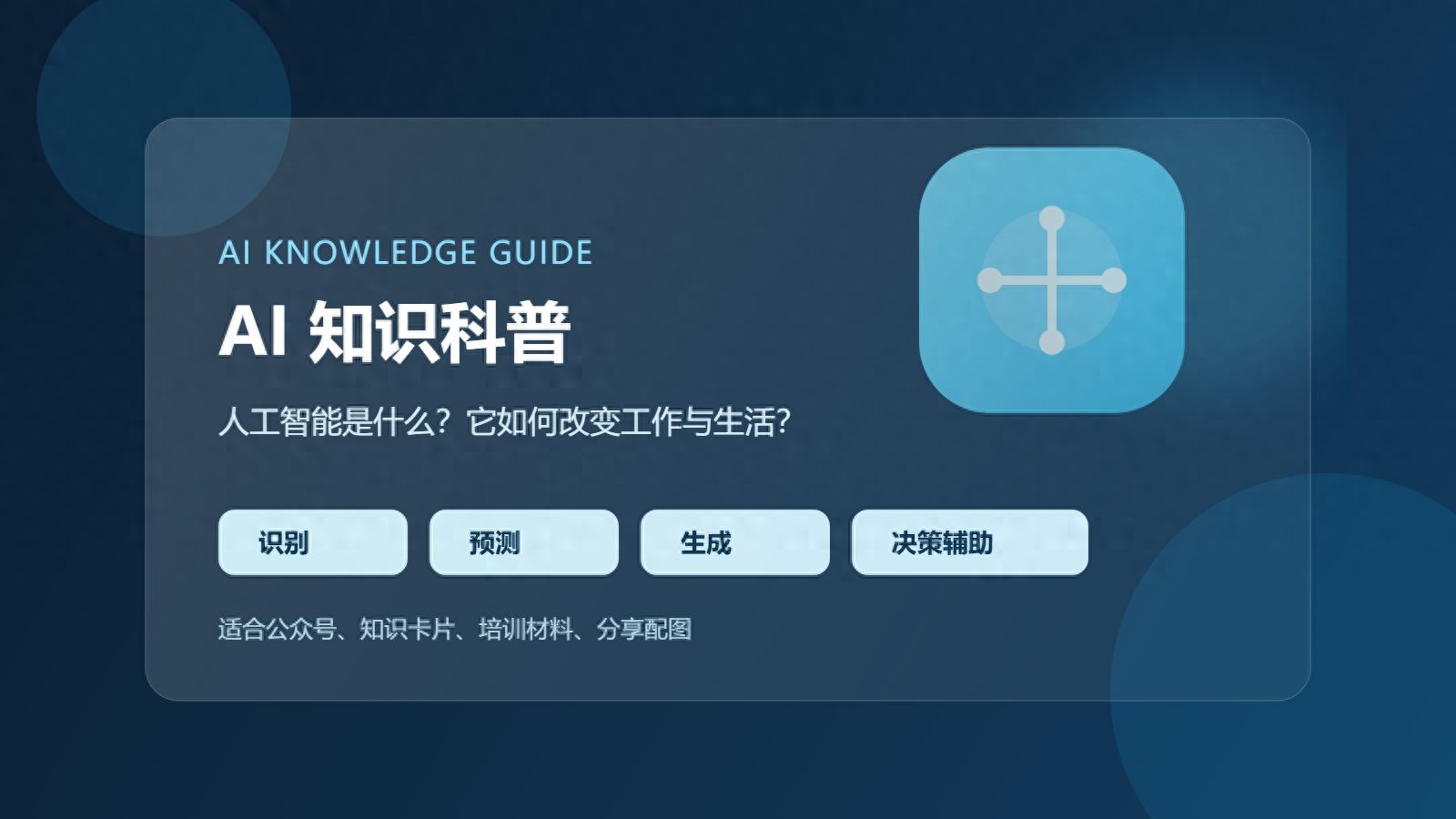
From an application perspective, AI mainly performs the following tasks:
- Recognition: Understanding images, speech, and text.
- Prediction: Judging what might happen next based on existing data.
- Generation: Creating text, images, videos, code, and other content.
- Decision Support: Helping humans analyze information quickly and provide suggestions.
Thus, AI is more like an increasingly capable “digital assistant” rather than a mysterious black box.
3. The Relationship Between AI, Machine Learning, and Large Models
Many people confuse AI, machine learning, and large models, but they represent a hierarchy:
- AI is the broadest concept, referring to the ability of machines to possess intelligent capabilities.
- Machine Learning is a method of implementing AI, focusing on enabling machines to learn patterns from data rather than relying solely on manually written rules.
- Deep Learning is a significant branch of machine learning that excels at processing complex information such as images, speech, and text.
- Large Models are a class of AI systems that have gained attention in recent years, typically characterized by vast parameters and strong general capabilities, capable of tasks like conversation, writing, summarizing, translating, and programming.
You can think of it this way:
AI is the goal, machine learning is the method, and large models are a powerful current form of implementation.
4. Why Has AI Suddenly Become So Popular in Recent Years?
AI is not a new concept, but it has rapidly gained traction in recent years due to three simultaneous developments:
1. Increasing Data Availability
The internet, mobile devices, and various digital platforms have accumulated vast amounts of text, images, audio, and behavioral data, providing ample material for AI learning.
2. Enhanced Computing Power
Improvements in chips and cloud computing capabilities have made it feasible to train models that previously required a long time, enabling complex tasks to be completed more quickly.
3. Significant Model Capability Improvements
The emergence of large language models has allowed ordinary users to intuitively realize that machines can not only “calculate” but also “write,” “answer,” “summarize,” and “create.”
This has brought AI from the laboratory into public applications, prompting various industries to rethink efficiency, content production, and service methods.
5. How is AI Already Affecting Our Lives?
Many people think of AI as a “future technology,” but it has already entered our daily lives.
1. Content Acquisition
Recommendation algorithms determine what content you are more likely to see on short video platforms and news platforms.
2. Work Collaboration
AI can help organize meeting minutes, draft initial documents, generate tables, and summarize information, significantly reducing repetitive labor.
3. Learning and Education
AI can provide personalized Q&A, language practice, and knowledge summaries, becoming a tool for assisting learning.
4. Healthcare and Services
In medical image recognition, health management, customer service robots, and intelligent consultations, AI has already provided substantial assistance.
5. Creative Production
From copywriting and posters to short video scripts, AI is becoming an “accelerator” for creators.
In other words, AI does not always appear as an independent product; more often, it is embedded in the tools and platforms we use.
6. Will AI Replace Humans?
This is one of the most common questions. A more accurate statement is not “Will AI replace all humans?” but:
AI will first replace some repetitive and standardized workflows while reshaping the skill requirements of many jobs.
For instance, basic organization, simple translation, template writing, and preliminary data summarization are tasks that AI can accelerate or even replace. However, jobs that involve complex judgment, emotional understanding, cross-domain integration, accountability, and creative decision-making still have a clear human advantage.
The more likely future scenario is:
- Those who do not use AI will fall behind in efficiency.
- Those who can use AI will spend more time on judgment, strategy, and creativity.
Therefore, rather than worrying about being completely replaced, it is better to learn how to collaborate with AI as soon as possible.
7. How Should Ordinary People Understand and Use AI?
For most people, understanding AI does not require starting with complex technical details; instead, three basic understandings can be established:
1. Treat AI as a Tool, Not an “Absolute Authority”
AI can make mistakes and may “speak nonsense” with confidence. It can help improve your efficiency but cannot replace your final judgment.
2. Learn to Ask Clear Questions
AI’s performance largely depends on how clearly you provide information. The more specific your questions and clearer your goals, the better the results are likely to be.
3. Start with High-Frequency Scenarios
For example, writing emails, summarizing, organizing materials, outlining, and generating event proposals. By starting with small tasks you encounter daily, the value of AI will quickly become apparent.
8. What is the Most Important Skill in the AI Era?
If the past emphasized “remembering answers,” then in the AI era, the more important skills will become:
- The ability to ask good questions
- The ability to judge the authenticity of information
- The ability to integrate information from multiple sources
- The ability to collaborate with tools
- The ability to maintain learning and adapt to changes
AI will lower many job thresholds but will also increase the value of “judgment” and “creativity.”
9. Conclusion: The Key is Not to Fear AI, but to Learn to Use It
Every technological revolution brings anxiety but also new opportunities. The significance of AI lies not only in making machines smarter but also in helping humans free up time from repetitive labor to engage in higher-value thinking, creativity, and connections.
For ordinary people, the best starting point is not to chase every concept but to take the first step: understand it, use it, and observe how it changes your work and life.
Once you start to truly engage with AI, it will no longer be just a distant technical term but will become part of your daily capabilities.
Comments
Discussion is powered by Giscus (GitHub Discussions). Add
repo,repoID,category, andcategoryIDunder[params.comments.giscus]inhugo.tomlusing the values from the Giscus setup tool.